A little over 4 years ago I saw Invisible Children for the first time. I could never have known that night that God would use that documentary to change my life forever.
Today, I bought a plane ticket to northern Uganda. I am going. Finally. I am going to see what I have only seen in pictures and films. I am going to meet the people whose children have been taken and whose lives have been forever altered by this terrible war. I am going to see the IDP camps they were forced to live in. I am going to see the situation that God has called me to be passionately committed to for the last 4 years. More importantly, I am going to see what God has done. I am going to see the New Life Center where girls who were once sex slaves in the LRA are now experiencing the healing power of the Gospel and hope through education, training and the opportunity for a new life. I am going to see, but I do not wish to simply see. I wish to be changed. I wish to wrestle through seeing the evil that man is capable of, and yet knowing that our God is still sovereign. I wish to be even the smallest spark of hope and love to these people who have suffered so much. I wish for them to know that though I have yet to meet them, I love them, and even more, God loves them.
I will be leaving early next Thursday morning on a 10 hour bus ride from Kigali to Kampala. I will spend Thursday night at the FH compound in Kampala and then early Friday morning I will fly from Kampala up north to Kitgum. I will be meeting Kate, another FH staff member, in Kitgum and we will be visiting the office there and also in Pader. Both Pader and Kitgum were home to large IDP camps during the war. We will be in the north through Sunday and then Monday morning I will fly back to Kampala and spend a few days there before heading back to Kigali.
Please pray for health and safety for me as I travel, as well as God's grace as I see and take in all that I will experience in northern Uganda. I anticipate it being a very emotionally draining experience. Please pray also that I would be able to be an encouragement to the FH staff working in northern Uganda, as well as the people there that I come into contact with.
I'll leave you with one of my favorite verses:
Micah 6:8 "He has shown you O man, what is good, and what does the Lord require of you? To act justly, love mercy and walk humbly with your God."
Thursday, October 8, 2009

Monday, October 5, 2009
Not the only Iowan in Rwanda...
For the past two weeks my parents have been periodically sending me links to aricles on the Des Moines Register's website by Perry Beeman, an environmental writer for the paper who also just arrived in Rwanda. For those of you who get the register, or visit the register's website, I'd invite you to follow his writings from Rwanda as well. This is his article from yesterday. It gave me chills to read it, both because of it's descriptions of the genocide memorials he visited, and because I quickly realized that out of hundreds of memorials in Rwanda, he visited the same two memorials I did.
Rwanda's genocide frozen in time at church memorials
by PERRY BEEMAN
pbeeman@dmreg.com
Kigali, Rwanda - Tuesday was my firstborn son's 26th birthday.
I spent it visiting spots in Rwanda where men and women and children of all ages were killed, some of them pregnant, simply because they were Tutsi. The ruling Hutu majority had issued the sickening order to "cut down the tall trees," a reference to many Tutsis' thin frames. Hutus wanted to end decades of conflict with Tutsis in an ethnic cleansing largely unrivaled outside of Nazi Germany.
I'm reporting in Rwanda through a fellowship with the International Reporting Project. I'm working on stories about the work Rwanda is doing to build an eco-friendly economy, 15 years after the genocide. Great Ape Trust of Iowa is heavily involved.
I've been here a couple of weeks, but this was my first chance to take in a genocide memorial.
There is a formal memorial in Kigali, the capital, which I also plan to see. But there are several other places, mostly churches, where the skulls, bones, and clothing of the Tutsis and moderate Hutus killed in the 1994 genocide are on display at the spot the people perished.
When I first saw the piles of clothes that were removed from 10,000 people killed in a Catholic church in Nyamata, southeast of Kigali, I thought I might wretch. I've seen gruesome things, and I had read plenty about the 1994 genocide before arriving in Rwanda, but nothing prepares one for this.
My second thought: How fortunate that my son, Scott, is alive and well and celebrating a birthday with his wonderful wife, Sheryl. How blessed I am to have another son, Joel, also alive and thriving. And a beautiful and loving wife, Jane, back home, safe. And my faithful dog, Carly. And my large, extended family. Events like this make you take stock. In a hurry.
Rwanda lost 800,000 to 1 million Tutsis and moderate Hutus in a few months in early 1994, when the Hutu majority launched a genocide after the plane carrying one of their own, President Juvénal Habyarimana, was shot down near the airport in Kigali.
You can watch "Sometimes in April" or "Hotel Rwanda," or read one of the many genocide books, but it's hard to imagine this event fully without seeing one of the rural churches where sanctuaries turned into mass graves.
Fresh from a couple of days of viewing some spectacular scenery and wildlife in Akagera National Park, I asked driver Jamada Muberuka about these church memorials. He offered to drive me to a couple.
First stop, Nyamata. The spot is quiet. Ribbons and flags of purple and white blow in the wind, the traditional colors used to mark observances of the genocide anniversaries. In 1990, Tutsis began moving here to escape threats elsewhere, said a memorial staffer, Martin Kalisa, through an interpreter. In 1992, two years before the genocide, 680 people were killed in this village, he said. Roadblocks ruled the day. The roaming Tutsis began dying of starvation. "There was no food. The soil was dry," Kalisa said. "Many starved."
Italian humanitarian Tonia Locatelli, who lived in a house next to the Catholic church, took to the international airwaves to tell the world of the starvation and suffering. "We must save these people. We must protect them," she pleaded. "It's the government itself which is doing this." It was 1992. On March 9, a soldier in a nearby tree shot Locatelli to death as she stood outside her home. She is buried outside the church.
In 1993, Tutsis were told that it was safe to return home, and they did. But as the war heated up and 1994 unfolded, they returned to the church, knowing they had survived there before. Kalisa isn't sure what day, but the Hutu forces showed up to find the church locked. They set off bombs that left holes in the concrete that are still there. They stormed in and killed 10,000 people hiding inside, with ponga knives (machetes), clubs and guns.
The clothes those people wore that day are stacked on the pews throughout the sanctuary. The altar stands clean and unblemished. Underground are the remains of 40,000 people, including many killed in the surrounding area. Above ground, the burial area is marked by a peaceful white tile with blue-tile crosses on top.
In one underground area is a display that includes the coffin of a pregnant woman who was raped, then stabbed to death. "This way, she is alone with her baby," Kalisa said.
Also on display are identification cards - left over from a system installed by Belgians that fanned the Tutsi and Hutu tensions - and jewelry. Rows of skulls, some missing pieces on top, are in a lit display surrounded by white tile.
We took steps down to an underground vault where neat rows of skulls and stacks of arm and leg bones were stacked on shelves. "Let us get out of here," said driver Jamada Muberuka. "Every time I come here, I get ..." He couldn't finish the sentence. "Those were tough times."
The tensions between Hutus and Tutsis went back decades, with several large outbreaks of violence from 1959 on. After 1990, tensions turned into rebel forces looking to throw the Hutus out of power. On July 4, 1994, current President Paul Kagame and his rebel forces took control and started building what they hoped would be a coalition government serving Rwandans, not Hutus and Tutsis. Much of the fighting shifted westward to the Democratic Republic of Congo next door, but Rwanda has kept peace.
We left this memorial and drove past the government-issue houses of genocide victims on our way to a second memorial, at Ntarama. The holes in the brick walls that were blown open with grenades are still there. The forces killed 5,000 here. The victims' clothes line the walls and hang from the rafters. The pongas and clubs used to kill those in the church are on display toward the front of the church, where a message, roughly translated, read, "If you had known about me and about yourself, you would not have killed me." It is a message still ringing with the disbelief that a human, a neighbor, a fellow villager, would kill another.
"People thought they would be safe here," driver Jamada said. "In our culture, our belief is that no one can do something wrong in a church."
The "wrong" here included storming into the kitchen-turned-mass-bedroom in a back building and setting mattresses on fire. The room still has cupboards and clothing scattered around.
A concrete wall sports an incomplete list of the dead. On this day, a breeze blew through, and the wide valley and hills presented a serene setting for such a disturbing place.
"It will not happen again," Jamada said. "Even those who were involved are regretting it."
It's an event that has consumed many people's vision of this country and its warm, friendly people. It's a beautiful, safe place with a lot to offer and, 15 years on, a growing economy and a sound government. Read the other items in my blog to get an idea of what this country is like now, with recovery well under way.
You might want to tell your family members something first. I'll go first: "I love you!"
Sunday, October 4, 2009
And then there were two...
This week was one of transition. Thursday morning 12 of the 15 Go ed students left for Uganda, and the remaining students left today for Giterama, about an hour outside of Kigali. Aryn and I are now the only ones living in our house. This will be quite an adjustment but I am looking forward to it. It will give me a chance to know Aryn better, as well as forcing me to to take more initiative in getting to know people at church and at the office better.
This week Aryn's new assistant also began work with FH. Her name is Vestine and she is truly a blessing to both of us. Her sweet spirit and incredible dependence on God are such an encouragement. I am so glad that I am getting a chance to spend a couple months working with her while I'm here. I will be helping Aryn to train her on simple accounting procedures and microsoft excel.
Rainy season is finally here. It has teased us for the last couple weeks but it is now consistently raining everyday. I enjoy the rain thus far, even though I have already gotten caught walking in it twice.
Even from Africa I am trying my best to follow the sports world. Glad to see the Hawkeyes, Cyclones and Vikings all doing pretty well! and only 3 weeks until the Spurs season starts!
Please pray for continued health for myself and the Go ed students. We had one student tested for parasites and one tested for malaria this week and both came back negative, but they are not feeling well nonetheless. Aryn has also been feeling sick and is going to the doctor tomorrow.
Thank you all for your continued support! I miss you all!
Hillary
This week Aryn's new assistant also began work with FH. Her name is Vestine and she is truly a blessing to both of us. Her sweet spirit and incredible dependence on God are such an encouragement. I am so glad that I am getting a chance to spend a couple months working with her while I'm here. I will be helping Aryn to train her on simple accounting procedures and microsoft excel.
Rainy season is finally here. It has teased us for the last couple weeks but it is now consistently raining everyday. I enjoy the rain thus far, even though I have already gotten caught walking in it twice.
Even from Africa I am trying my best to follow the sports world. Glad to see the Hawkeyes, Cyclones and Vikings all doing pretty well! and only 3 weeks until the Spurs season starts!
Please pray for continued health for myself and the Go ed students. We had one student tested for parasites and one tested for malaria this week and both came back negative, but they are not feeling well nonetheless. Aryn has also been feeling sick and is going to the doctor tomorrow.
Thank you all for your continued support! I miss you all!
Hillary
Sunday, September 27, 2009
Oh, how He loves us..
My big undertaking of the weekend was downloading the new David Crowder CD off itunes. A simple enough sounding task turned into a 5 hour project with our internet connection. It was definitely worth it. Sometimes it just makes me laugh a little that I'm living in Africa but we still spend our evenings online and watching movies.
This week the study abroad students were gone doing a research project about an hour out of Kigali. It was nice to have the house to myself for a few days. Wednesday night our part time cook Shakira took me to the market and then taught me how to make some traditional African dishes. It was great to learn how to make some things and even better to get to spend some time with Shakira. Shakira came over to cook on Thursday again and Friday the students got back. I was very ready for them to come back by that point. This Thursday the students will leave for good to go on to Uganda. I will definitely miss having them around.
Today myself and three other girls were walking into town for lunch after church, which is quite a walk. Suddenly an American woman in a pickup stopped and asked us if we wanted a ride somewhere. She asked us if we were from FH, we said yes, and she explained that she and her husband currently have a staff member from FH living at their house. Her husband is the president of World Relief in Rwanda. I felt immediately that it was no accident that I had crossed paths with this woman. I felt like she was someone I could really connect with, and I am excited to pursue that relationship. Especially with the students leaving, it is going to be important for me to get to know people around the city. It is exciting to see God open doors for this to happen.
This week the study abroad students were gone doing a research project about an hour out of Kigali. It was nice to have the house to myself for a few days. Wednesday night our part time cook Shakira took me to the market and then taught me how to make some traditional African dishes. It was great to learn how to make some things and even better to get to spend some time with Shakira. Shakira came over to cook on Thursday again and Friday the students got back. I was very ready for them to come back by that point. This Thursday the students will leave for good to go on to Uganda. I will definitely miss having them around.
Today myself and three other girls were walking into town for lunch after church, which is quite a walk. Suddenly an American woman in a pickup stopped and asked us if we wanted a ride somewhere. She asked us if we were from FH, we said yes, and she explained that she and her husband currently have a staff member from FH living at their house. Her husband is the president of World Relief in Rwanda. I felt immediately that it was no accident that I had crossed paths with this woman. I felt like she was someone I could really connect with, and I am excited to pursue that relationship. Especially with the students leaving, it is going to be important for me to get to know people around the city. It is exciting to see God open doors for this to happen.
Monday, September 21, 2009
A restful weekend
This past weekend was great. They were the first days since I've been here that I really had nothing in particular that I needed to be at or get done. Saturday morning I slept in (does 7:30 count as sleeping in?) and then went to a market down the road that sells mostly food products and fabrics. One great thing about Kigali is that it's really easy to find inexpensive fabric and then find a seamstress who can make you whatever you want out of the fabric - skirts, purses, computer bags, etc - also inexpensively. It was my first time at this market and I was a little too overwhelmed by colors and patterns to actually buy any fabric, but it was fun to look around and see the possibilities. Saturday afternoon was spent reading and hanging out with the students at the house.
Sunday morning I went with Aryn to the large Anglican church in Kigali that she attends. It offers an English speaking service that attracts many American and UK citizens who are in Kigali. As I stood there during worship I was overwhelmed with the realization of how much I had missed corporate worship over the last couple weeks. It was so refreshing to be in the presence of God with other believers that way again. After church my friend Rachel and I went downtown to a coffee shop/restaurant called Bourbon to eat lunch and read. This Kigali based chain has actually recently reached the states and it has a very Western feel. While it feels like cheating the African experience to visit Bourbon too often, It's a nice break once in a while. We also visted a craft co-op downtown that features a lot of beautiful African jewelry and souvenirs for really cheap. I'm sure I will make several more trips there while I'm here.
I also had today off thanks to a Rwandan public holiday. This morning I continued my shopping spree and went with several girls to Amahoro, a Christian organization that employs women who might not otherwise have income to sew all kids of bags, clothing, bed spreads and other items which they sell in a shop on the premesis. These women are incredibly talented and had alot of beautiful things.
After lunch today, all the students along with Aryn and Kate left for Giterama, a small town about an hour outside of Kigali, where they will be for the rest of the week. The empty house made for a nice quiet ending to a relaxing weekend.
I am excited for another week of learning about the city and the people of Rwanda. My prayer is that as I go through this week I will also feel a strong sense of God's purpose and direction. Often times short term trips like this can feel very self-centered. I get to learn so much and I am working for an organization that does so much for the Kingdom but how much can I contribute in such a short time? I know that God has a specific reason for my coming here and I want to feel that reason and purpose even as I go through my work in the office here and interact with the people I come into contact with.
Sunday morning I went with Aryn to the large Anglican church in Kigali that she attends. It offers an English speaking service that attracts many American and UK citizens who are in Kigali. As I stood there during worship I was overwhelmed with the realization of how much I had missed corporate worship over the last couple weeks. It was so refreshing to be in the presence of God with other believers that way again. After church my friend Rachel and I went downtown to a coffee shop/restaurant called Bourbon to eat lunch and read. This Kigali based chain has actually recently reached the states and it has a very Western feel. While it feels like cheating the African experience to visit Bourbon too often, It's a nice break once in a while. We also visted a craft co-op downtown that features a lot of beautiful African jewelry and souvenirs for really cheap. I'm sure I will make several more trips there while I'm here.
I also had today off thanks to a Rwandan public holiday. This morning I continued my shopping spree and went with several girls to Amahoro, a Christian organization that employs women who might not otherwise have income to sew all kids of bags, clothing, bed spreads and other items which they sell in a shop on the premesis. These women are incredibly talented and had alot of beautiful things.
After lunch today, all the students along with Aryn and Kate left for Giterama, a small town about an hour outside of Kigali, where they will be for the rest of the week. The empty house made for a nice quiet ending to a relaxing weekend.
I am excited for another week of learning about the city and the people of Rwanda. My prayer is that as I go through this week I will also feel a strong sense of God's purpose and direction. Often times short term trips like this can feel very self-centered. I get to learn so much and I am working for an organization that does so much for the Kingdom but how much can I contribute in such a short time? I know that God has a specific reason for my coming here and I want to feel that reason and purpose even as I go through my work in the office here and interact with the people I come into contact with.
Thursday, September 17, 2009
Settling in...
I am starting to feel much more at home in Kigali. Yesterday things seemed to just start to "click". I am learning to speak english in a way that is more understandable for my Rwandan co-workers - no contractions and just generally speaking slower and enunciating. I also feel much more comfortable navigating the city. I walk to and from work when it's nice and I've been trying to take advantage of that since rainy season will be here soon and I will have to take public transport most of the time.
Today I took the morning off from work and Aryn, the sort of "house mom" for the study abroad students and the only full time resident of the compound I live at, took me downtown to get me oriented to that area. We visited a fairly modern shopping center with a very modern grocery store. We also went through a craft co-op, and even stopped in the actual hotel from Hotel Rwanda. There is no indication inside or outside of the hotel that it was indeed where that event took place. I think they think it would be bad for business. It was hard at first here not to be consumed with dwelling on this country's past. The genocide was all I knew about the country before coming and going to memorials right away just reinforced that. I had a real sense of uneasiness and fear about being here the first few days, but now that I am getting to know the current culture, it is so encouraging to see how far they have come and where they are now. Aryn and Kate advised me to avoid watching any documentaries or reading too much about the genocide while I am here.
This week I met a girl named Breanne who is also interning at a nonprofit here in Kigali. She is a senior at Wheaton, not far from Trinity. It was great to meet her and trade Chicago familiarities. I am hoping that I will be able to hang out with her more often and get a little America fix.
I am also very excited to share with all of you that my trip has been full funded! Thanks so much to all of you who contributed! God is so faithful to continually provide what I need!
Hillary
Today I took the morning off from work and Aryn, the sort of "house mom" for the study abroad students and the only full time resident of the compound I live at, took me downtown to get me oriented to that area. We visited a fairly modern shopping center with a very modern grocery store. We also went through a craft co-op, and even stopped in the actual hotel from Hotel Rwanda. There is no indication inside or outside of the hotel that it was indeed where that event took place. I think they think it would be bad for business. It was hard at first here not to be consumed with dwelling on this country's past. The genocide was all I knew about the country before coming and going to memorials right away just reinforced that. I had a real sense of uneasiness and fear about being here the first few days, but now that I am getting to know the current culture, it is so encouraging to see how far they have come and where they are now. Aryn and Kate advised me to avoid watching any documentaries or reading too much about the genocide while I am here.
This week I met a girl named Breanne who is also interning at a nonprofit here in Kigali. She is a senior at Wheaton, not far from Trinity. It was great to meet her and trade Chicago familiarities. I am hoping that I will be able to hang out with her more often and get a little America fix.
I am also very excited to share with all of you that my trip has been full funded! Thanks so much to all of you who contributed! God is so faithful to continually provide what I need!
Hillary
Sunday, September 13, 2009
Cows mountain climbing on Bat Island..welcome to Kibuye..
This weekend all of the FH Go ed students, staff and myself went to Kibuye, Rwanda, a small tourist town on Lake Kivu, near the border of Rwanda and the Democratic Republic of the Congo (DRC).
This area of the country is incredibly beautiful. We drove through three hours of mountains and Lake Kivu itself is well above sea level. The hotel itself was slightly questionable, and my roommate Rachel and I got moved to a different room after the toilet started leaking in ours and flooded our bathroom. Our shower then did the same thing to our second room's bathroom.
The weekend was a time for myself and the students to relax while staff members spent time placing students in month long practicum assignments for October. Lake Kivu has a large methane bubble underneath it, which make swimming dangerous in some places, but also makes it impossible for fish and other animals to survive, making swimming in the safe spots much more enjoyable.
Saturday we went hik ing on "Bat Island". This island lived up to its name! About 5 minutes into the hike we began to hear the shrieking of bats and approached a tree that contained literally thousands of them. Our Rwandan guides began clapping and even throwing rocks into the tree which sent thousands of bats flying into the air over us. After surviving that encounter, we trekked the rest of the way up the huge hill of Bad Island, and enjoyed the view from the top. Through the fog we could see the outline of the mountains of the Congo. Throughout the hike we were puzzled to find cow droppings along our path, even up towards th
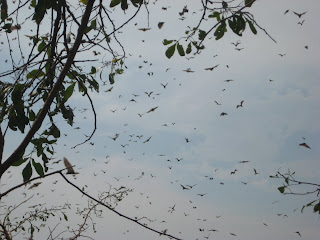 e top. I am still not exactly sure how they manage to climb the rocky hill, but swam to the island as well!
I also did a lot of reading. I am working through a book called A Thousand Hills, which is an autobiography of current Rwandan president and former rebel army leader Paul Kagame, and also a broader overview of the history of Rwanda. I am realizing that to be most effective here, I must understand the history of Rwanda, the genocide and how it has effected the people even today. I am hoping this book will help me do that.
The thing that has struck me most in my first few days in Rwanda is seeing evidence of the reality of conflicts that I have only read about. Not only were the genocide memorials incredible evidence of the horrific events of Rwanda, but as we drew closer to Kibuye we saw a convoy of UN peacekeeping vehicles headed to the Congo. These conflicts are very real as well.
A few specific prayer requests:
Some of you may have heard about recent riots in Kampala, Uganda. While this is far from us, the Go ed students are supposed to be heading to Kampala in 2 weeks, and a couple of our staff members this week. Please prayer that these riots will be resolved and that the FH members in Kampala will be safe.
When the Go ed students leave in two weeks, I will be alone with one other staff member and a housekeeper living on the compound. All of you know me well enough to know that I am very much a people person, and I am somewhat concerned about the amount of time I may be spending by myself in the evenings. Please pray that I will be comfortable with this time, and use it to rely on God as my foremost companion and best friend in a way I have never had the opportunity to before.
Thank you for all of your continued support! and for enduring through this abnormally long post. I love you all!
Hillary
This area of the country is incredibly beautiful. We drove through three hours of mountains and Lake Kivu itself is well above sea level. The hotel itself was slightly questionable, and my roommate Rachel and I got moved to a different room after the toilet started leaking in ours and flooded our bathroom. Our shower then did the same thing to our second room's bathroom.
The weekend was a time for myself and the students to relax while staff members spent time placing students in month long practicum assignments for October. Lake Kivu has a large methane bubble underneath it, which make swimming dangerous in some places, but also makes it impossible for fish and other animals to survive, making swimming in the safe spots much more enjoyable.
Saturday we went hik
 ing on "Bat Island". This island lived up to its name! About 5 minutes into the hike we began to hear the shrieking of bats and approached a tree that contained literally thousands of them. Our Rwandan guides began clapping and even throwing rocks into the tree which sent thousands of bats flying into the air over us. After surviving that encounter, we trekked the rest of the way up the huge hill of Bad Island, and enjoyed the view from the top. Through the fog we could see the outline of the mountains of the Congo. Throughout the hike we were puzzled to find cow droppings along our path, even up towards th
 e top. I am still not exactly sure how they manage to climb the rocky hill, but swam to the island as well!
I also did a lot of reading. I am working through a book called A Thousand Hills, which is an autobiography of current Rwandan president and former rebel army leader Paul Kagame, and also a broader overview of the history of Rwanda. I am realizing that to be most effective here, I must understand the history of Rwanda, the genocide and how it has effected the people even today. I am hoping this book will help me do that.
The thing that has struck me most in my first few days in Rwanda is seeing evidence of the reality of conflicts that I have only read about. Not only were the genocide memorials incredible evidence of the horrific events of Rwanda, but as we drew closer to Kibuye we saw a convoy of UN peacekeeping vehicles headed to the Congo. These conflicts are very real as well.
A few specific prayer requests:
Some of you may have heard about recent riots in Kampala, Uganda. While this is far from us, the Go ed students are supposed to be heading to Kampala in 2 weeks, and a couple of our staff members this week. Please prayer that these riots will be resolved and that the FH members in Kampala will be safe.
When the Go ed students leave in two weeks, I will be alone with one other staff member and a housekeeper living on the compound. All of you know me well enough to know that I am very much a people person, and I am somewhat concerned about the amount of time I may be spending by myself in the evenings. Please pray that I will be comfortable with this time, and use it to rely on God as my foremost companion and best friend in a way I have never had the opportunity to before.
Thank you for all of your continued support! and for enduring through this abnormally long post. I love you all!
Hillary
Subscribe to:
Posts (Atom)